


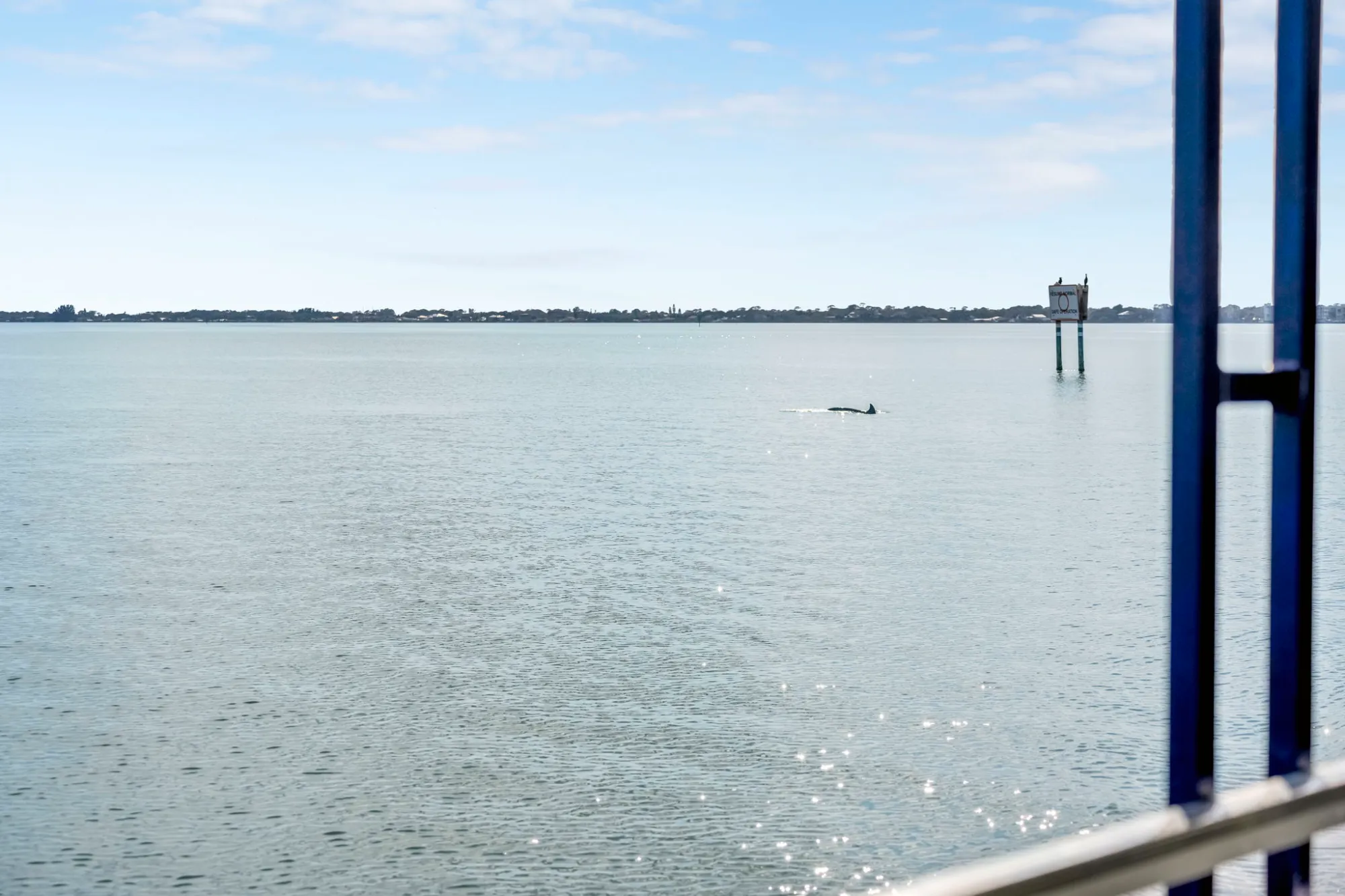
A gray fin cuts the surface near the mangroves. Everyone turns. Then the water opens into a slow flat circle twenty feet off the bow, closes again, and nothing comes up. That one was not a dolphin. A dolphin and manatee tour in Cocoa Beach puts you on top of both, because both animals live in the same shallow water behind our barrier island, and the daily 2.5-hour wildlife trip on the lagoon covers them in one run. They just do not announce themselves the same way. Dolphins arrive. Manatees leave you a clue and make you work out the rest. Some mornings we get both before the dock is out of sight. Some mornings the manatees never come up anywhere near where people happen to be looking. Wild animals, open water, no promises.
What One Trip on the Banana River Covers
From the Causeway Dock to the Thousand Islands
Cocoa Beach Eco Tours runs out of one dock. One, at 333 W Cocoa Beach Causeway, and our Dolphin & Wildlife Boat Tour is 2.5 hours on a pontoon from there.
From the dock we turn onto the Banana River Lagoon. It sits behind the barrier island, which is why it handles rough weather considerably better than the open ocean does, and why we are out there on days when nobody is going offshore. A few minutes later you are in the Thousand Islands. Mangrove islets, dozens of them, channels running between.
Those channels are the productive territory. Wildlife concentrates in them, and a pontoon draws so little water that we can follow where a deeper hull has to turn around. That is most of the reason this works at all.
Our captains hold no-wake speeds through the stretches that need it. Quieter boat, smaller wake. You can hear what is being pointed out, which on a loud boat you cannot.
People ask about this when they book, so: there is no separate manatee trip. Same water, same boat, same 2.5 hours. Dolphins and manatees come as a pair whether you planned it that way or not.
Resident Bottlenose Dolphins Work the Channels Year-Round
Our dolphins are not passing through on the way somewhere better. They live here. You can tell by how little attention they pay to the boat.
They usually show up first. Often before the dock is out of sight behind us, close enough that nobody bothers with binoculars.
Give a kid one thing to watch for and the trip sharpens up. Groups split and reform all day, so your count of four turns into two, then six, then four again. Sometimes a pod will herd a school of fish into a ball. You will miss that one unless somebody names it for you first. And a calf swims tight against its mother, near enough to touch. See it once, see it every trip after.
There is more on the animals themselves, and on the dolphin trips through the Thousand Islands, if you want the longer version.
Manatees Stay All Year and Gather in Cool Water
Manatees are here all year as well. What changes is how far apart they are.
Below about 68 degrees they start running into trouble, and they cannot stay in cold water long. So when it cools off they crowd into the warm sheltered spots. Fewer places to go, more animals in each one. That is the whole reason winter works better. Nothing to do with migration.
Best odds run November through March. The days right after a cold front beat a warm stretch, every time, and most of our regulars know to watch the forecast rather than the calendar. There is a month-by-month guide to manatee season on the Banana River if you are building a trip around them.
Their positioning comes down to feeding. A manatee can spend eight hours a day consuming seagrass and similar vegetation. Eight. So they stay glued to the grass flats, and the margins where those flats meet the channels are the water worth watching.
Telling Them Apart by Fin, Swirl and Snout
Nobody explains this before a first trip, and it is the part that actually matters. Underwater the two look nothing alike. At the surface you get half a second and a shape, and that is where people get it wrong.
Dolphin. A gray dorsal fin, curved, unmistakably a fin. Short, thick snout. Moves steadily, generally in company, working the channel margins where the feeding happens.
Manatee. Often no fin at all. A slow round swirl where one just went down. Sometimes a back, a snout, a tail, one flipper. Sometimes just a breath you hear before you see anything at all. Get a clear look and you will find two flippers and a wide paddle of a tail.
The technique that beats all the others: a manatee surfaces every three to five minutes. So when the swirl opens, do not scan around. Stare at that same patch of water and wait it out. It comes back up roughly where it went down.
Bring polarized sunglasses. We say this to everyone and about half take it seriously. They strip the glare off the surface and let you see a foot or two under it, which is where everything is happening.
Birds and Rays Fill the Gaps Between Sightings
Plenty occupies the quieter stretches. Herons, egrets, ibis, roseate spoonbills, ospreys, all working the flats. Rays sliding over pale sand wherever visibility allows.
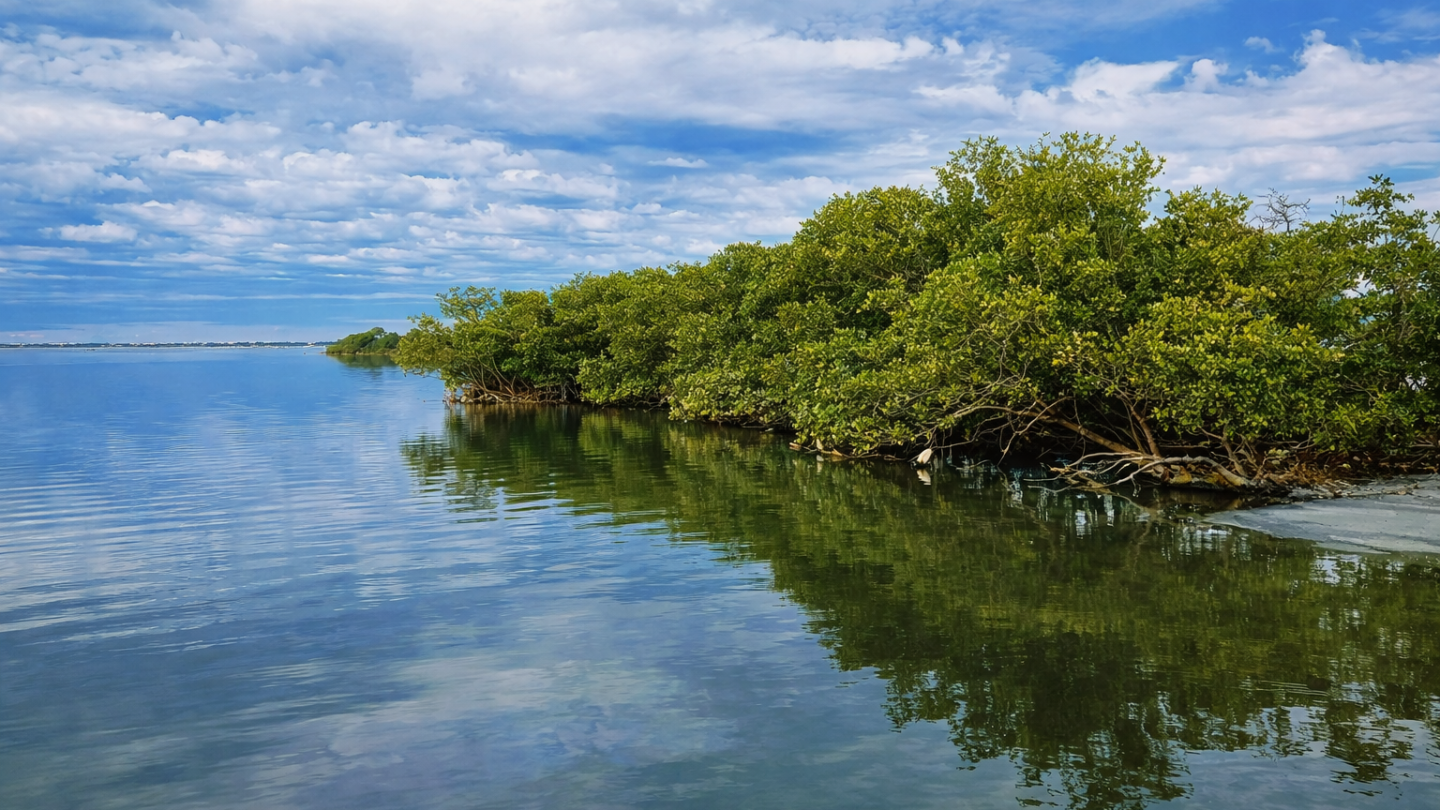
Calm Water, Good Light and Room to Watch
Morning and Late Afternoon Help Spotting
We run daily: morning, midday, afternoon. Morning and late afternoon deliver the flattest water and the most forgiving light for identifying dolphins. Both conditions help even more with manatees, because a swirl on glassy water is obvious and a swirl in chop is effectively invisible.
Distance Rules Protect Both Species
Fifty yards. That is what NOAA asks boaters to keep off wild dolphins, and it is further than people picture. No sudden throttle changes near them. Never put the boat between a mother and her calf. And do not feed them, which is illegal anyway and bad for the animals besides. Read their marine life viewing guidelines with the kids before you come. It turns a list of rules into a job.
Manatees are covered three times over, by the Marine Mammal Protection Act of 1972, the Endangered Species Act of 1973 and Florida’s own Manatee Sanctuary Act of 1978. FWC calls it harassment if you change how the animal behaves. Broad, until you flip it around. Did it react to you? Then you were too close. Our captains work to that test rather than counting yards. Their viewing guidelines also note where you can legally get in the water with one in Florida. Crystal River and Kings Bay, other side of the state.
Frequently Asked Questions
Can you see dolphins and manatees on the same tour in Cocoa Beach?
Yes. That is the trip. Both animals use the same water, so one 2.5-hour run gets you dolphins, manatees and whatever birds are working the flats. Manatee sightings climb when it cools off. None of it is guaranteed, and if conditions are bad we would rather tell you at the dock than after you have paid.
Do Cocoa Beach dolphin tours run on the Banana River or the ocean?
The lagoon, every time. Behind the barrier island, not out through the inlet. It stays flat on days the Atlantic does not, which matters for seeing things as much as for comfort.
What time of year is best for seeing manatees?
November through March, though they never actually leave. Colder temperatures push them into the warmer pockets and they bunch up there, so you get the same number of animals spread across far less water. Dolphins do not care what month it is.
Can you swim with or touch the dolphins or manatees?
No. We do not offer it and nobody on this lagoon does. Both species are federally protected, and touching, feeding or chasing either one will land you in real trouble. If swimming with manatees is what you came to Florida for, that is Crystal River and Kings Bay, over on the Gulf side.
How long does the trip last?
Two and a half hours on the water, leaving from the same dock every time.
Next Steps for Wildlife Watchers
- Morning or late afternoon if spotting is the priority.
- Chasing manatees? November through March, and read the month-by-month guide before you pick a week.
- Polarized sunglasses. Hat, sunscreen, water.
- Read NOAA’s viewing guidelines with the kids the night before.
- Watch for the swirl, not the animal. That one habit is the difference between seeing manatees and missing them.
Two animals in the same shallow water, found in completely different ways. One shows up. The other leaves a ripple and waits. Most of what people miss out there, they miss by looking somewhere else a few seconds too early.


